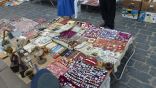
Once there was Kievan Rus, and it included the duchy of Galicia-Volhynia which by time became a kingdom of its own. Its king Danylo founded a city which he named after his son Lev, whence the name Lviv. The kingdom was later swallowed by Poland. When Poland was partitioned between Austria, Prussia and Russia at the end of the 18th century, Lviv became a Habsburg city. After WWI and the collapse of the Habsburg Empire, Lviv was back in Poland. It was fist after WWII that Lviv came under the rule from Moscow. Lviv has long been a centre for Ukrainian nationalism, and this is difficult to miss in the souvenirs being offered. Or for that matter that restaurant my friend Sergei took me to. We knocked the door, and there is a guy with a fake Kalashnikov asking for the password. (Which of course is Slava Ukraini!)
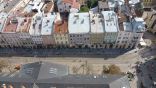
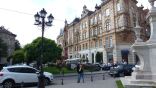
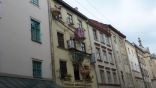
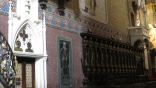
Lviv is also a city of beauty. Its old town is a UNESCO World Heritage site. It's packed with fine buildings, not the least from the Habsburg era. There is also a lot of churches, although I was not able to get into many of them. On Saturday there were weddings, and on Sunday there was mass. Lviv is a very lively town, with a lot of people out. Some of them tourists, obviously, but not all. Lots of nice cafés along the streets, and Lviv is overall a lot more appealing than Kiev.
| Main page Ukraine | Svensk version |